Bundles start at $49 per bottle on the 6-bottle option, with a 60-day money-back guarantee from the purchase date.
Check Visivra PricePaid linkAstaxanthin at a glance
| Fact | Detail |
|---|---|
| Type | Carotenoid (xanthophyll), red pigment |
| Common source | Microalgae (Haematococcus pluvialis) |
| Main role | Antioxidant; studied for eye fatigue |
| Food sources | Salmon, trout, shrimp, krill |
| Studied dose | 9 mg/day for 6 weeks (2023 trial) |
| Safety reference | EFSA: up to 8 mg/day from supplements safe for adults |
| Dose in Visivra | Not published — check label |
| Evidence | Some — small, industry-funded trial |
What is astaxanthin?
Astaxanthin is a carotenoid in the same family as lutein and zeaxanthin, but deep red rather than yellow. Microalgae produce it to protect themselves from intense sunlight; fish and shellfish that eat the algae store it, which is why wild salmon flesh is pink. Supplements usually use astaxanthin extracted from the alga Haematococcus pluvialis.
How astaxanthin is thought to work
Astaxanthin is a powerful antioxidant in laboratory tests and can span cell membranes, which may help protect them from oxidative damage. For the eyes, researchers have proposed two effects:
- reducing oxidative stress in the retina and eye tissues during intense visual work;
- easing tension in the ciliary muscle, the tiny muscle that changes the lens’s focus for close work.
These ideas are plausible but not proven in humans.
Compare the 2-, 3- and 6-bottle bundles on the seller’s checkout page. Read the label and check with your doctor if you take medication.
Check Visivra PricePaid linkThe 2023 screen-work trial
The best-known recent study (Sekikawa et al., Journal of Clinical Biochemistry and Nutrition, 2023) was a randomised, double-blind, placebo-controlled trial:
| Detail | Finding |
|---|---|
| Participants | 60 healthy adults (20–64) doing regular screen (VDT) work |
| Dose | 9 mg astaxanthin per day |
| Duration | 6 weeks |
| Main result | In people 40 and over, dominant-eye visual acuity after screen work was better with astaxanthin than placebo |
| No difference | In people under 40; in functional visual acuity; in pupil constriction |
| Funding | The astaxanthin supplier (NutraIngredients) |
This is a promising but small result with a clear conflict of interest. It suggests astaxanthin may help some older screen users; it does not show a broad benefit.
Astaxanthin and AMD
The Linus Pauling Institute mentions a trial in 74 people with intermediate AMD that gave 4 mg astaxanthin together with lutein, zeaxanthin, vitamins C and E, zinc, copper and fish oil, and found less progression than placebo. Because astaxanthin was one of many ingredients, the effect cannot be credited to astaxanthin alone.
Safety and dose
The European Food Safety Authority (EFSA) concluded that astaxanthin intake up to 8 mg/day from food supplements, plus normal dietary intake from fish and shellfish, is safe for adults. The 2023 eye trial used 9 mg/day for six weeks. [Visivra astaxanthin dose from label]
Interactions
No major drug interactions are well established. As with other fat-soluble carotenoids, take it with food. If you take medication, are pregnant or breastfeeding, or have a medical condition, check with your doctor — safety data for these groups are limited.
Astaxanthin’s role in Visivra
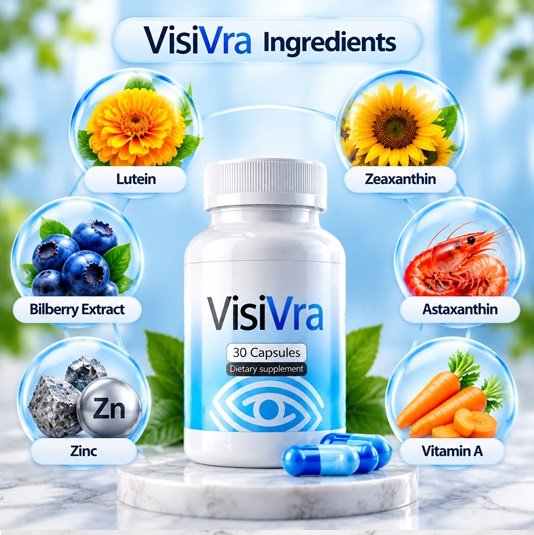
Astaxanthin is the ingredient most closely tied to Visivra’s screen-strain message. It adds a well-tolerated antioxidant with early, mixed evidence for eye fatigue in people over 40. Its value depends on the dose: the trial used 9 mg/day, and EFSA’s safety view goes up to 8 mg/day from supplements.
Bottom line
Astaxanthin is a credible, generally safe addition with a small amount of supporting human research — mostly funded by ingredient makers. It may help some older screen users; it is not a substitute for screen breaks, blinking and correct glasses.* If screen fatigue is your main reason for considering Visivra, try the habits in our digital eye strain guide for two weeks first — then you’ll know how much of the problem is left for a supplement to address.
Visivra is sold through the seller’s own checkout (BuyGoods). Confirm the total, shipping and guarantee terms before you pay.
Check Visivra PricePaid linkFrequently asked questions
Does astaxanthin help with eye strain?
One small 2023 trial found less drop in visual acuity after screen work in people over 40 taking 9 mg/day. There was no difference in younger participants or in other measures.
How much astaxanthin is safe?
EFSA concluded up to 8 mg/day from supplements, plus normal diet, is safe for adults.
Where does astaxanthin come from?
Mainly microalgae (Haematococcus pluvialis). It is also found in salmon, trout, shrimp and krill.
Is astaxanthin better than lutein?
Not for macular pigment — lutein and zeaxanthin have far more evidence. Astaxanthin is studied for different effects, such as eye fatigue.
How much astaxanthin is in Visivra?
Not published on the sales page. Check the label.
Sources
- Sekikawa T. et al. Effects of diet containing astaxanthin on visual function in healthy individuals: a randomized, double-blind, placebo-controlled, parallel study. J Clin Biochem Nutr. 2023;72(1):74–81
- NutraIngredients — Astaxanthin supplements may reduce visual stress from screens: RCT (study funding details)
- EFSA — Safety of astaxanthin for its use as a novel food in food supplements
- Linus Pauling Institute, Oregon State University — Carotenoids
Every source above was opened and checked when this page was last updated (October 18, 2026).
*These statements have not been evaluated by the Food and Drug Administration. Visivra is not intended to diagnose, treat, cure, or prevent any disease. This page is general information, not medical advice — talk to your doctor or eye-care professional before starting any supplement, especially if you are pregnant, nursing, take medication or have an eye condition.