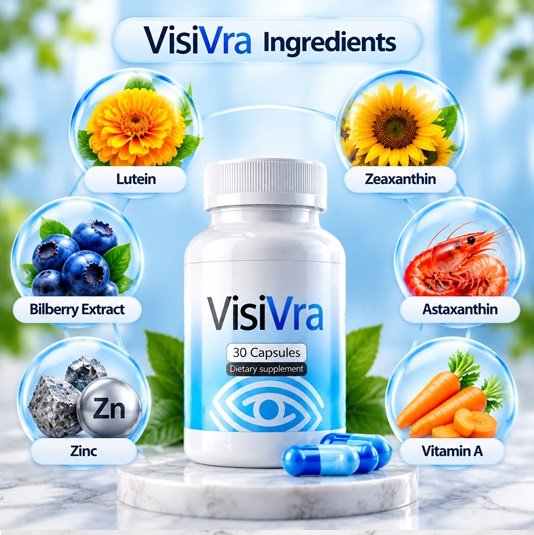
Bundles start at $49 per bottle on the 6-bottle option, with a 60-day money-back guarantee from the purchase date.
Check Visivra PricePaid linkBilberry Extract at a glance
| Fact | Detail |
|---|---|
| Type | Berry extract (Vaccinium myrtillus) |
| Active compounds | Anthocyanins (purple-blue pigments) |
| Traditional use | Vision, night sight, circulation, blood sugar |
| Studied amounts | Fruit extracts up to 160 mg/day for up to 6 months |
| Dose in Visivra | Not published — check label |
| Evidence | Weak — rigorous night-vision trials found no benefit |
| Key caution | Pregnancy safety unknown; leaves unsafe at high doses |
What is bilberry?
Bilberry (Vaccinium myrtillus) is a small, dark-blue berry from Northern Europe, related to the blueberry. Its intense colour comes from anthocyanins, antioxidant pigments also found in blackcurrants, red cabbage and blueberries. Supplements usually use an extract standardised to a stated percentage of anthocyanins — check the label for that figure.
The night-vision story
Bilberry’s reputation grew from a popular story that pilots ate bilberry jam to see better on night missions. The story spread widely, and bilberry became a classic ingredient in eye formulas. Modern research has not backed it up.
Compare the 2-, 3- and 6-bottle bundles on the seller’s checkout page. Read the label and check with your doctor if you take medication.
Check Visivra PricePaid linkHow bilberry is thought to work
The theory is that anthocyanins:
- act as antioxidants in the retina;
- may support small blood vessels, including those that supply the eye;
- may help regenerate rhodopsin, the light-sensing pigment used in dim light.
These effects are seen mainly in laboratory and animal studies. The jump to clear benefits in human eyes has not been made.
What the research shows
NCCIH, part of the US National Institutes of Health, summarises the evidence:
- Bilberry has not been clearly shown to help any health condition.
- Studies of night vision have had conflicting results, and the most rigorous studies found no benefit for night vision in healthy people.
- It has also been used traditionally for high blood sugar, but evidence of effectiveness is lacking.
Some small studies have looked at bilberry for eye fatigue or dry eye, often in combination products. They are too small and varied to draw firm conclusions.
Studied amounts
NCCIH reports that bilberry fruit extracts up to 160 mg per day, used for up to six months in research studies, appeared well tolerated. That gives a useful reference point when you read your Visivra label. [Visivra bilberry dose and anthocyanin % from label]
Side effects and safety
- Bilberry fruit is considered safe in amounts normally found in food.
- Extracts up to 160 mg/day for six months appeared well tolerated in studies.
- Bilberry leaves may be unsafe at high doses or with long-term use — check that your product uses fruit extract.
- Pregnancy and breastfeeding: little is known about safety of amounts larger than food.
Interactions
NCCIH advises talking to your health care provider before using bilberry if you take any medicine, because some herbs and medicines interact. People taking blood thinners or diabetes medication often ask about bilberry; the government sources we checked do not give a specific warning, so the safest course is to ask your pharmacist.
Bilberry’s role in Visivra
Bilberry adds anthocyanin antioxidants and a traditional “eye herb” to the formula. It is unlikely to cause harm at studied amounts, but it is also unlikely to be what makes a difference. We would rather see the space used for higher, clearly labelled doses of lutein and zeaxanthin.
Bottom line
Bilberry is a classic eye ingredient with a great story and weak evidence. NCCIH’s summary is blunt: no clear benefit for any condition, and no night-vision benefit in the best studies. It is a harmless-looking addition to Visivra for most adults, but not a reason to buy it.*
Visivra is sold through the seller’s own checkout (BuyGoods). Confirm the total, shipping and guarantee terms before you pay.
Check Visivra PricePaid linkFrequently asked questions
Does bilberry improve night vision?
The most rigorous studies found no benefit for night vision in healthy people, according to NCCIH.
Is bilberry the same as blueberry?
They are close relatives. Bilberries are smaller, darker throughout and richer in anthocyanins.
Is bilberry safe?
Bilberry fruit is safe in food amounts, and extracts up to 160 mg/day for six months appeared well tolerated. Little is known about pregnancy safety.
Can I take bilberry with medication?
Talk to your provider first. NCCIH advises this for any medicine because herbs and drugs can interact.
Why is bilberry in Visivra?
It is a traditional eye ingredient that adds anthocyanin antioxidants. The evidence for eye benefits is weak.
Sources
Every source above was opened and checked when this page was last updated (October 18, 2026).
*These statements have not been evaluated by the Food and Drug Administration. Visivra is not intended to diagnose, treat, cure, or prevent any disease. This page is general information, not medical advice — talk to your doctor or eye-care professional before starting any supplement, especially if you are pregnant, nursing, take medication or have an eye condition.