Bundles start at $49 per bottle on the 6-bottle option, with a 60-day money-back guarantee from the purchase date.
Check Visivra PricePaid linkA quick tour of the retina
Light enters the eye through the cornea and lens and lands on the retina, a thin layer of light-sensing tissue at the back of the eye. Two kinds of cells do the sensing:
- Rods work in dim light and handle night and peripheral vision. They use a pigment called rhodopsin, which is built from vitamin A.
- Cones work in bright light and handle colour and fine detail. They are packed most densely in the macula, a small area about 5 mm across, and especially in its centre, the fovea.
The retina is one of the most metabolically active tissues in the body. It uses a lot of oxygen and is constantly exposed to light — a combination that produces oxidative stress. Much of the nutrition science around eye health is about how the eye protects itself from that stress.
Step 1: Building the macular pigment
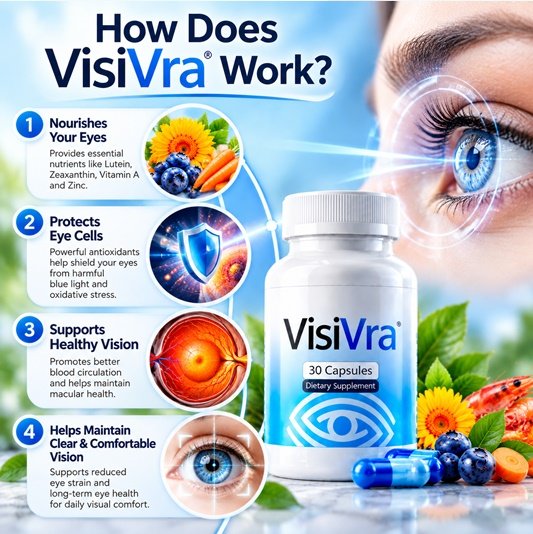
The macula looks yellow because it is coloured by lutein, zeaxanthin and meso-zeaxanthin (which the body makes from lutein). The Linus Pauling Institute notes this macular pigment can absorb up to 90% of blue light, depending on its density, which may reduce light-induced oxidative damage.
Your body cannot make lutein or zeaxanthin, so they must come from food — leafy greens such as spinach and kale, egg yolks, corn and orange or yellow peppers — or from supplements. Trials show that supplementing with lutein and zeaxanthin raises macular pigment density over weeks to months. This is Visivra’s most evidence-based mechanism.
Step 2: Antioxidant support
Visivra adds two antioxidants on top of the carotenoids:
- Astaxanthin, a red carotenoid from microalgae, is a strong antioxidant in laboratory studies. One human trial found less drop in visual acuity after screen work in people over 40 taking 9 mg/day for six weeks; other measures did not change.
- Bilberry contains anthocyanins, the purple-blue pigments in berries. They are antioxidants in the lab, but NCCIH reports the most rigorous human studies found no night-vision benefit.
Lab antioxidant power does not always translate into effects in the human eye. That gap is why we treat these two ingredients as the weaker part of the formula.
Compare the 2-, 3- and 6-bottle bundles on the seller’s checkout page. Read the label and check with your doctor if you take medication.
Check Visivra PricePaid linkStep 3: Supporting retinal chemistry
Every time a rod cell detects light, rhodopsin changes shape and has to be rebuilt. That cycle needs vitamin A. According to the NIH Office of Dietary Supplements, night blindness is the first sign of vitamin A deficiency.
Zinc is concentrated in the retina and helps move vitamin A from the liver to the eye and use it there. The NIH notes zinc was part of the AREDS formula that slowed progression of intermediate AMD in high-risk adults.
The key point: these nutrients correct shortfalls. If you already get enough from food, extra amounts are unlikely to make your vision sharper — and both have upper limits.
How the pieces fit together
| Step | Ingredient(s) | What it supports | Strength of evidence |
|---|---|---|---|
| Filter blue light | Lutein, zeaxanthin | Macular pigment density | Good (many trials; AREDS2) |
| Neutralise oxidative stress | Astaxanthin, bilberry | Antioxidant defences | Limited / mixed |
| Rebuild light-sensing pigment | Vitamin A | Rhodopsin, night vision | Good for deficiency |
| Help use vitamin A | Zinc | Retinal enzymes | Good for deficiency; AREDS for AMD |
The design is coherent. Whether it delivers depends on the doses, which Visivra’s sales page does not list, and on your baseline diet.
How long does it take?
Nutrients that build up in tissue work slowly. Macular pigment rises gradually over weeks to months of daily intake. The astaxanthin trial ran for six weeks. Bilberry studies varied.
So if you try Visivra, give it a consistent few weeks before judging — but keep the 60-day guarantee (counted from purchase) in mind. We suggest a check-in around day 45. Our guarantee timeline lays this out.
What Visivra does not do
Visivra does not change the shape of your eye or lens, so it cannot fix the need for glasses. It cannot unblock drainage in glaucoma, clear a cataract or repair a damaged retina. Screen-related eye strain is mostly caused by focusing effort, reduced blinking and glare — habits like the 20-20-20 rule, blinking and screen positioning address those directly.
If you notice vision changes, the right first step is an eye exam. A supplement can be discussed afterwards.
The honest bottom line
Visivra’s mechanism is built on well-understood eye biology. The lutein–zeaxanthin step is well supported; the vitamin A and zinc steps matter most for people who are low; the astaxanthin and bilberry steps are plausible but weakly proven. Without published doses and without a trial on the finished product, Visivra may support eye health, but no one can promise how much.*
Visivra is sold through the seller’s own checkout (BuyGoods). Confirm the total, shipping and guarantee terms before you pay.
Check Visivra PricePaid linkFrequently asked questions
Does Visivra block blue light?
Its lutein and zeaxanthin may help build the macular pigment, which naturally absorbs blue light inside the eye. It does not work like blue-light glasses and the effect builds slowly.
How fast does Visivra work?
Carotenoids build up over weeks to months. Most studies ran six weeks or longer. Results vary from person to person.
Will Visivra improve my eyesight?
It cannot correct refractive errors. It may support normal eye function if your diet is low in these nutrients.*
Do I need Visivra if I eat leafy greens?
Maybe not. A diet rich in spinach, kale, eggs and colourful vegetables provides lutein, zeaxanthin and vitamin A. A supplement is most likely to help people who eat few of these foods.
Is the science behind Visivra proven?
The individual mechanisms are well studied, especially for lutein and zeaxanthin. The finished Visivra formula has not been tested in a published trial.
Sources
- Linus Pauling Institute, Oregon State University — Carotenoids
- National Eye Institute — Age-Related Eye Disease Studies (AREDS/AREDS2): major findings
- NIH Office of Dietary Supplements — Vitamin A and Carotenoids: Health Professional Fact Sheet
- NIH Office of Dietary Supplements — Zinc: Health Professional Fact Sheet
- NCCIH — Bilberry: Usefulness and Safety
- Sekikawa T. et al. Effects of diet containing astaxanthin on visual function in healthy individuals: a randomized, double-blind, placebo-controlled, parallel study. J Clin Biochem Nutr. 2023;72(1):74–81
- American Academy of Ophthalmology — Computers, Digital Devices, and Eye Strain
Every source above was opened and checked when this page was last updated (October 18, 2026).
*These statements have not been evaluated by the Food and Drug Administration. Visivra is not intended to diagnose, treat, cure, or prevent any disease. This page is general information, not medical advice — talk to your doctor or eye-care professional before starting any supplement, especially if you are pregnant, nursing, take medication or have an eye condition.