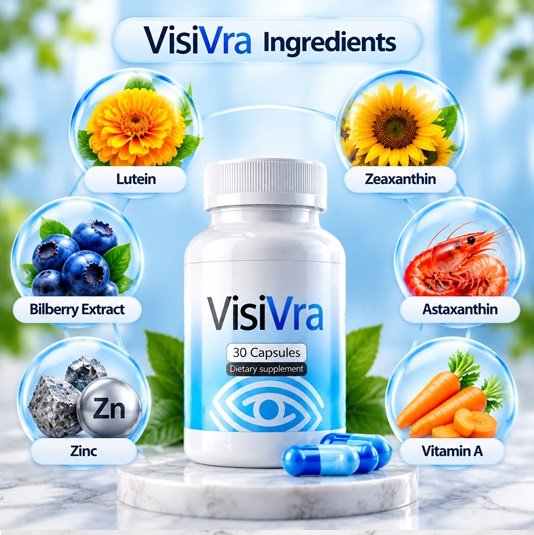
Bundles start at $49 per bottle on the 6-bottle option, with a 60-day money-back guarantee from the purchase date.
Check Visivra PricePaid linkLutein at a glance
| Fact | Detail |
|---|---|
| Type | Carotenoid (xanthophyll) |
| Where it acts | Macula and lens of the eye |
| Main role | Forms macular pigment; absorbs blue light; antioxidant |
| Food sources | Spinach, kale, other leafy greens, egg yolk, corn |
| Studied doses | 6–20 mg/day in trials; 10 mg in AREDS2 |
| Dose in Visivra | Not published — check label |
| Evidence | Good for macular pigment; good in intermediate AMD (with zeaxanthin) |
What is lutein?
Lutein is one of about 600 carotenoids — the pigments that colour plants yellow, orange and red. Humans can’t make it, so it must come from food or supplements. Along with zeaxanthin and meso-zeaxanthin, it forms the macular pigment, the yellow layer at the centre of the retina. According to the Linus Pauling Institute, lutein and zeaxanthin are also the only carotenoids found in the human lens.
How lutein works in the eye
The macular pigment sits in front of the light-sensing cones in the central retina. Depending on its density, it can absorb up to 90% of blue light before it reaches those cells, which may reduce light-induced oxidative damage. Lutein is also an antioxidant in its own right, neutralising reactive molecules formed when light and oxygen meet.
A denser macular pigment has been linked in studies with better contrast sensitivity and glare recovery — the ability to see detail against a bright background and recover after a flash of light.
Compare the 2-, 3- and 6-bottle bundles on the seller’s checkout page. Read the label and check with your doctor if you take medication.
Check Visivra PricePaid linkWhat the research shows
- Macular pigment: supplementing lutein raises macular pigment density over weeks to months.
- Visual function: the Linus Pauling Institute summarises a meta-analysis of eight trials that found improved visual acuity and contrast sensitivity with lutein and/or zeaxanthin, at 6–20 mg/day lutein.
- AMD: in AREDS2, a formula including 10 mg lutein and 2 mg zeaxanthin reduced progression from intermediate to advanced AMD by about 25%. Compared with beta-carotene, lutein/zeaxanthin reduced progression to late and neovascular AMD.
- Cataract: high dietary intake is linked to lower cataract risk in observational studies, but AREDS2 supplements had no effect on cataracts.
- Observational data: people with the highest lutein + zeaxanthin intake had a lower risk of advanced AMD in large US cohorts; about 6 mg/day from food was linked with lower risk compared with under 2 mg/day.
How much lutein has been studied?
| Study / context | Lutein dose |
|---|---|
| AREDS2 (with 2 mg zeaxanthin) | 10 mg/day |
| Meta-analysis range | 6–20 mg/day |
| Dietary intake linked to lower AMD risk | ~6 mg/day from food |
One cup of cooked frozen spinach provides about 29.8 mg of lutein + zeaxanthin, according to the Linus Pauling Institute — so food can easily match supplement doses.
Food sources
- Spinach and kale (very high in lutein)
- Other leafy greens: collards, turnip greens, Swiss chard
- Egg yolks (lower amounts, but very well absorbed)
- Corn, peas, broccoli, Brussels sprouts
- Yellow and orange peppers
Cooking, chopping and eating these foods with some fat improves absorption. See Foods for eye health.
Side effects and safety
Lutein is generally well tolerated at the doses studied. AREDS2 participants took 10 mg/day for years without major safety signals. Very high carotenoid intake from any source can tint the skin slightly yellow, which is harmless and fades when intake drops. As with any supplement, talk to your doctor if you are pregnant, breastfeeding or have a medical condition.
Interactions
No major drug interactions are well established for lutein. Because it is fat-soluble, medicines that block fat absorption (such as orlistat) may reduce how much you absorb. Taking several carotenoid supplements together is unnecessary — check labels for duplicate lutein.
Lutein’s role in Visivra
Lutein is the foundation of Visivra’s formula and its best-supported ingredient. Whether it delivers depends on the amount per serving. If the label shows around 10 mg, that matches AREDS2 and the middle of the research range. If it shows 1–2 mg, the effect is likely to be much smaller than in the studies. [Visivra lutein dose from label]
Bottom line
Lutein is one of the few eye-supplement ingredients with consistent human evidence. It supports the macular pigment and, at AREDS2 doses, helped slow intermediate AMD. It does not prevent cataracts in supplement form, and it is easy to get from leafy greens. In Visivra it is the right ingredient to lead with — the open question is the dose.*
Visivra is sold through the seller’s own checkout (BuyGoods). Confirm the total, shipping and guarantee terms before you pay.
Check Visivra PricePaid linkFrequently asked questions
What does lutein do for the eyes?
It forms part of the macular pigment, which filters blue light and acts as an antioxidant in the central retina.
How much lutein should I take?
There is no official daily requirement. Trials used 6–20 mg/day; AREDS2 used 10 mg with 2 mg zeaxanthin. Ask your doctor what suits you.
Is lutein safe long term?
It has been used for years at 10 mg/day in AREDS2 without major safety issues.
Can I get enough lutein from food?
Yes. A cup of cooked spinach provides far more than most supplements.
How much lutein is in Visivra?
The sales page does not say. Check the Supplement Facts on the bottle.
Sources
- Linus Pauling Institute, Oregon State University — Carotenoids
- National Eye Institute — Age-Related Eye Disease Studies (AREDS/AREDS2): major findings
Every source above was opened and checked when this page was last updated (October 18, 2026).
*These statements have not been evaluated by the Food and Drug Administration. Visivra is not intended to diagnose, treat, cure, or prevent any disease. This page is general information, not medical advice — talk to your doctor or eye-care professional before starting any supplement, especially if you are pregnant, nursing, take medication or have an eye condition.